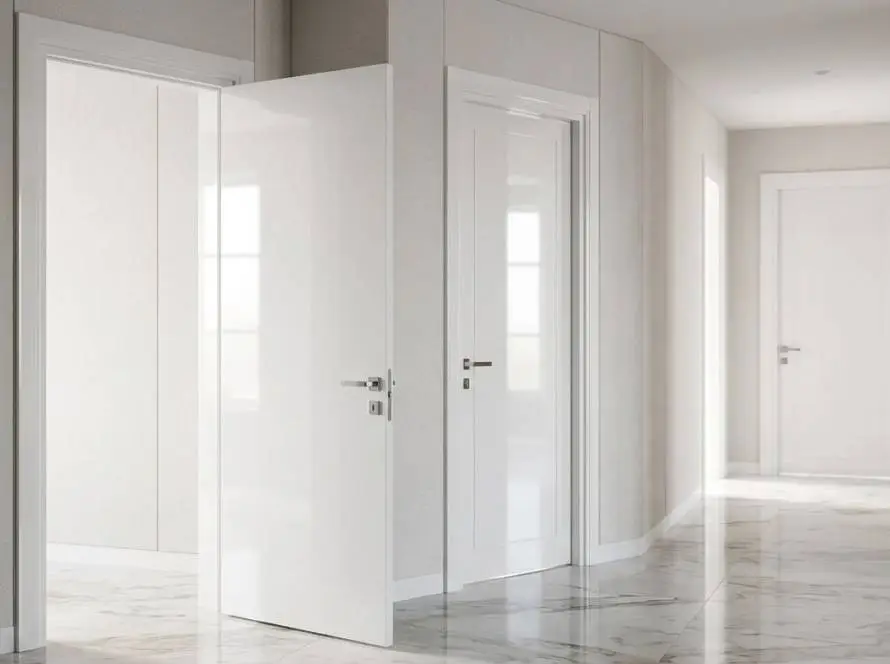

Melamine doors dominate hotel corridors, apartment complexes, and commercial buildings worldwide. But what exactly is melamine, how are these doors made, and is it the right choice for your project? This guide answers everything.
TABLE OF CONTENTS
- What Is a Melamine Door?
- How Melamine Doors Are Made
- Technical Features & Specifications
- Pros & Cons
- Melamine vs Lacquer vs PVC
- Are Melamine Doors Good for Hotels?
- Design Options & Finishes
- How to Order Melamine Doors from Turkey
- FAQ
What Is a Melamine Door?
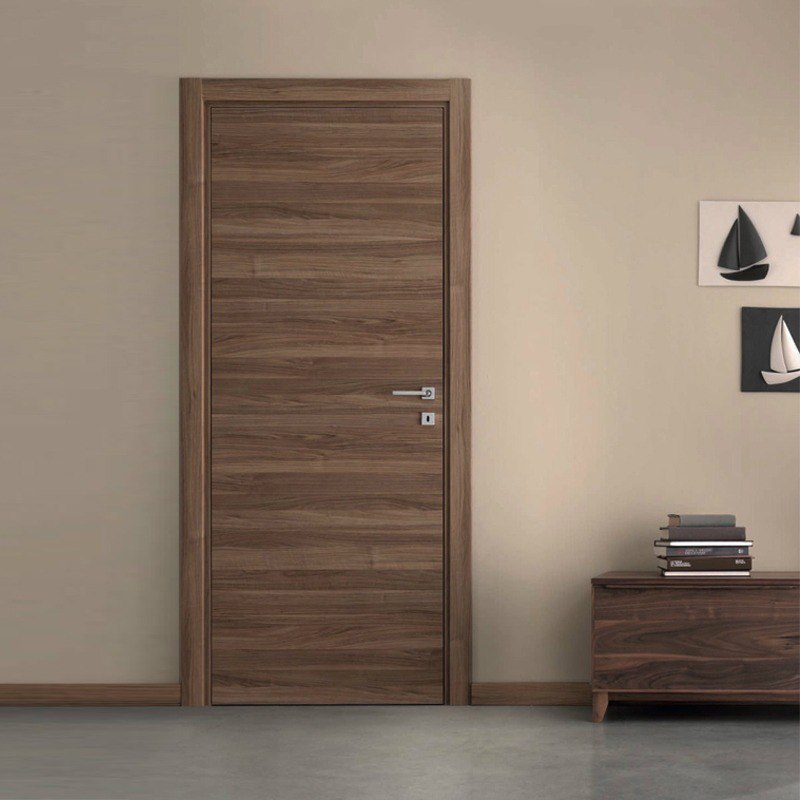
A melamine door is an interior door whose surface is covered with melamine-impregnated paper, which is then fused to an engineered wood core (typically MDF or HDF) under high heat and pressure. The result is a hard, smooth, and highly durable surface that resists moisture, scratches, and everyday wear.
The term “melamine” refers to the thermosetting resin — melamine formaldehyde — that saturates decorative paper and bonds it permanently to the substrate. This is not a paint or coating applied on top; it becomes part of the panel itself, which is why melamine surfaces are so hard-wearing.
Melamine doors are among the most widely used interior doors in the world, found in everything from budget apartments to four- and five-star hotel rooms, schools, hospitals, and office buildings.
How Melamine Doors Are Made
Understanding the manufacturing process helps you evaluate quality when comparing suppliers.
1. Core Preparation
The door core is engineered from MDF (Medium Density Fiberboard) or HDF (High Density Fiberboard). HDF is denser, heavier, and more resistant to impact and moisture — it’s the preferred core for commercial and hotel projects. Some budget products use a honeycomb or chipboard core, which reduces weight but also durability.
2. Melamine Paper Lamination
Decorative paper printed with the desired pattern (wood grain, solid color, marble, etc.) is impregnated with melamine resin. This paper is then placed on both faces of the core and pressed at 150–200°C under 25–30 bar pressure. The resin cures and creates an inseparable bond.
3. Profiling & Milling
Once laminated, CNC routers mill the door to its final profile — whether flat, grooved, paneled, or textured. The edges are then treated with matching ABS or PVC edge banding to protect the core from moisture ingress.
4. Frame & Assembly
The door leaf is fitted into a frame (typically matching melamine-clad MDF) and hinges, closers, and hardware are fitted. In factory settings like Eurasia Door, the complete door set — leaf, frame, threshold, and architrave — is supplied as a single kit for easy site installation.
QUALITY TIP
Always ask your supplier for the core density (kg/m³) and edge banding thickness. Premium melamine doors use HDF cores above 850 kg/m³ and 2mm ABS edge banding. Thinner edge banding (0.4–1mm) is a cost-cutting measure that leads to delamination in humid environments.
Technical Features & Specifications
Here are the key technical specifications you should request from any melamine door manufacturer:
| SPECIFICATION | STANDARD GRADE | PREMIUM / HOTEL GRADE |
|---|---|---|
| Core Material | MDF 680–720 kg/m³ | HDF 850–950 kg/m³ |
| Surface | Melamine paper, 80–120 g/m² | Melamine paper, 120–160 g/m² |
| Edge Banding | PVC 0.4–1mm | ABS 2mm, laser edge |
| Door Leaf Thickness | 35mm | 40–45mm |
| Surface Hardness | ≥90 N (Brinell) | ≥120 N (Brinell) |
| Moisture Resistance | Standard | MR/E1 rated, low formaldehyde |
| Sound Insulation | 28–32 dB Rw | 32–38 dB Rw |
| Fire Rating (optional) | E30 | E30 / E60 (with intumescent seals) |
Pros & Cons of Melamine Doors
Advantages
- Exceptional durability: The fused surface resists scratches, impacts, and everyday abrasion better than most paint finishes.
- Moisture resistance: Unlike solid wood, melamine-clad MDF/HDF does not warp or swell under normal humidity conditions.
- Design versatility: Available in hundreds of decors — from realistic wood grains and stone effects to solid colors (RAL, NCS).
- Cost efficiency: Melamine doors offer excellent performance at a lower price point than lacquered or solid wood doors — ideal for large-volume projects.
- Easy maintenance: Clean with a damp cloth. No special products required. The surface does not need re-painting or re-sealing.
- Consistency: Factory-made panels deliver perfect color and texture consistency across thousands of units — critical for hotel projects.
- Low formaldehyde options: E0 and E1 rated boards are available for projects with strict indoor air quality requirements.
Limitations
- Not refinishable: Unlike painted or lacquered doors, melamine surfaces cannot be sanded and re-coated if damaged.
- Edge vulnerability: Cheap edge banding can peel in very damp environments (bathrooms, pool areas). Specify laser-edged ABS for wet areas.
- Limited repairability: Deep chips or cracks are difficult to repair invisibly — but this is rarely an issue with high-density cores.
- Perceived value: In ultra-luxury segments, clients may perceive melamine as less premium than natural veneer or lacquer.
Melamine vs Lacquer vs PVC: Which Should You Choose?
| CRITERION | MELAMINE | LACQUER | PVC / WPC |
|---|---|---|---|
| Price Point | ★★☆ Medium-Low | ★★★ Medium-High | ★☆☆ Low-Medium |
| Surface Durability | ✓ Excellent | Good (can chip) | Good |
| Moisture Resistance | Good | Good | ✓ Excellent |
| Design Range | ✓ Very wide | ✓ Very wide (custom color) | Moderate |
| Luxury Perception | Medium | ✓ High | Low-Medium |
| Best For | Hotels, apartments, offices | Boutique hotels, villas | Wet areas, humid climates |
| Volume Orders | ✓ Ideal | Possible (longer lead time) | ✓ Ideal |
| Fire Rating | ✓ Available | ✓ Available | Limited |
Our recommendation: For hotel guest room doors in the 4-star segment and above, melamine (or melamine + lacquer combination) delivers the best balance of performance, aesthetics, and cost. For ultra-luxury projects, consider natural veneer or lacquer. For bathrooms and humid areas, PVC/WPC is the safest choice
Are Melamine Doors Good for Hotels?
Absolutely — and here’s why the hospitality industry relies on them.
A typical 200-room hotel needs 600–800 door sets (guest rooms, bathrooms, closets, service corridors). Consistency of appearance, durability over thousands of open-close cycles, and ease of replacement are all critical factors. Melamine doors excel on every one of these:
- Factory production ensures perfect color matching across all units, even when ordering in phases
- HDF cores withstand luggage impact, trolley bumps, and frequent cleaning without degrading
- Surfaces clean easily with standard hotel housekeeping products
- Fire-rated versions (E30, E60) comply with hospitality safety regulations
- Lead times for large orders are predictable — typically 45–90 days ex-works from Turkish manufacturers
PROJECT REFERENCE
Eurasia Door has supplied melamine door sets to hotel projects across Southeast Europe, the Middle East, and Central Asia — including properties operating under international flags. We supply complete door kits: leaf, frame, hardware, and factory-fitted seals. Request our hotel door brochure →
Design Options & Finishes
Modern melamine printing technology can replicate virtually any aesthetic:
Classic panel design — traditional aesthetic
Contemporary flat panel — modern interiors
- Wood grain decors: Oak, walnut, pine, wenge, ash, teak — hundreds of realistic reproductions
- Solid colors: Any RAL or NCS color matched to your interior scheme
- Stone & concrete effects: Marble, travertine, cement — increasingly popular in boutique hotels
- Textured surfaces: Synchronous texture where the emboss pattern matches the print, giving an exceptionally realistic feel
- Glossy & matte finishes: From high-gloss lacquer-like surfaces to ultra-matte soft-touch
- Combined designs: Melamine body with lacquer or grooved panel inserts
How to Order Melamine Doors from Turkey
Turkey is one of the world’s leading exporters of interior doors, combining competitive pricing with manufacturing quality that meets European standards. Here’s how a typical order works with Eurasia Door:
- RFQ / Inquiry: Submit your project details — quantity, door dimensions, design preferences, delivery country
- Proforma Invoice: We issue a detailed offer within 2–3 business days
- Sample Approval: Physical door samples or material swatches dispatched for approval
- Production: Lead time 30–45 days depending on quantity and customization
- Shipping: We work with all Incoterms — EXW, FOB , CIF, DAP to your site
- Documentation: CE marking, test reports, country-of-origin certificates provided
Minimum order quantities start from 50 door sets for standard sizes. Custom dimensions are available from 1 piece with appropriate lead time adjustments.
Frequently Asked Questions
Is melamine the same as laminate?
They are related but not identical. Both use resin-impregnated paper. The key difference is thickness and density: melamine uses a single decorative paper layer fused directly to the board. High-pressure laminate (HPL) uses multiple layers pressed at higher pressure, creating a thicker, even harder surface. For most interior door applications, melamine is perfectly adequate. HPL is specified for extreme-wear applications like hospital doors and high-traffic public spaces.
Can melamine doors be used in bathrooms?
Standard melamine doors can handle bathroom humidity when properly installed with adequate ventilation. However, for very wet environments or coastal climates, we recommend specifying MR (Moisture Resistant) HDF cores and sealed edge banding. Alternatively, consider our PVC/WPC door range, which is entirely waterproof.
What is the typical lifespan of a melamine door?
In residential settings, a quality melamine door lasts 20–30 years. In commercial/hotel settings with HDF cores and proper hardware (heavy-duty hinges, door closers), you can expect 15–20 years of service before aesthetic refresh is needed.
Are melamine doors eco-friendly?
Modern melamine doors are manufactured with E1 or E0 formaldehyde emission standards, making them safe for indoor use. The MDF/HDF core uses wood fibers from managed forests. Boards certified to PEFC or FSC standards are available on request. The long service life also means fewer replacements and less material consumption over time.
What is the difference between melamine and lacquered doors?
A melamine door has its decorative layer fused into the surface during manufacturing. A lacquered door is painted with polyurethane or polyester lacquer in a spray booth, creating a higher-gloss, more premium finish. Lacquered doors offer a wider custom color range and higher perceived luxury, but typically cost 25–60% more than equivalent melamine doors and have longer production lead times. Also for Lacquer Doors you can check our next article.